By Eat Local / August 07, 2024
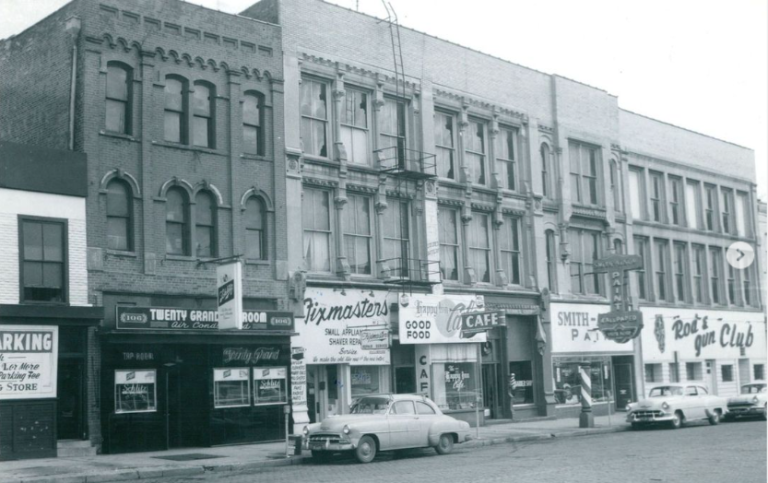
Recently Rosie’s Pub, a beloved fixture in downtown Bloomington, has been in the news with the announcement of owner Molly Bradle stepping away from the business. This transition marks yet another chapter in the long and storied history of 106 E. Front St., and it seems fitting to take a look back at not just the history of Rosie’s, but the fascinating story of the building itself, which has been a cornerstone of Bloomington’s food and social scene for over 150 years.
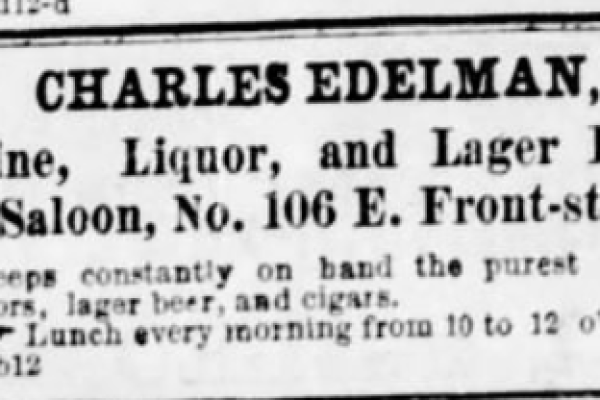
The story begins around 1870 with the construction of what later became known as the Heffernan building at 106 E. Front St. In its inaugural year, 1870-1871, the building housed a bar owned by “Wooley G. A.” Shortly after, in the early 1870s, a new restaurant opened under the proprietorship of Charles Edelman. This establishment faced an early setback when it caught fire, but Edelmann was undeterred. He renovated the building, upgrading it with “all the improvements of a first-class restaurant,” setting a high standard for the location’s future.
Between 1875 and 1882, the building changed hands several times, briefly becoming home to various businesses including a publishing company, a printer, and even a shooting gallery, showcasing the diverse commercial landscape of 19th-century Bloomington.
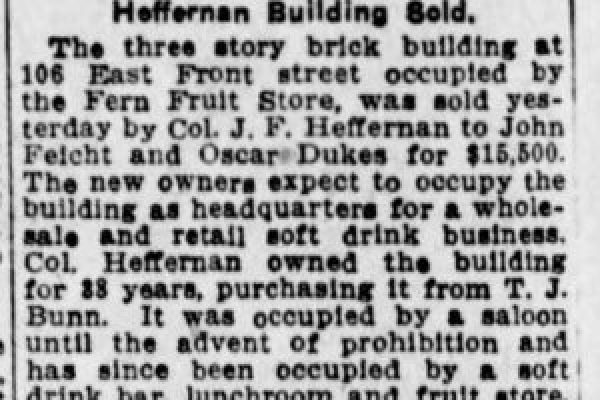
A pivotal moment came in 1882 when John F. Heffernan purchased the building, giving it the name it still bears today. Under Heffernan’s ownership, the space operated as a saloon, adopting various names including the “Businessman’s Headquarters” and the “Elks Saloon.” This incarnation lasted until 1907, with Heffernan, busy with various business and community involvements, selling the bar to Ike Friedman in 1905.
Friedman continued to run the business as the Elks Saloon until 1914, when prohibition made Bloomington “dry.”
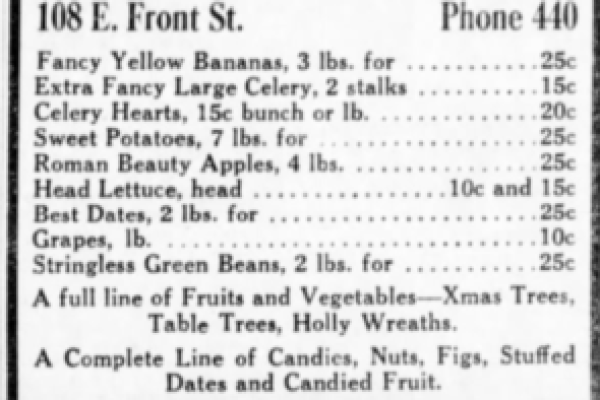
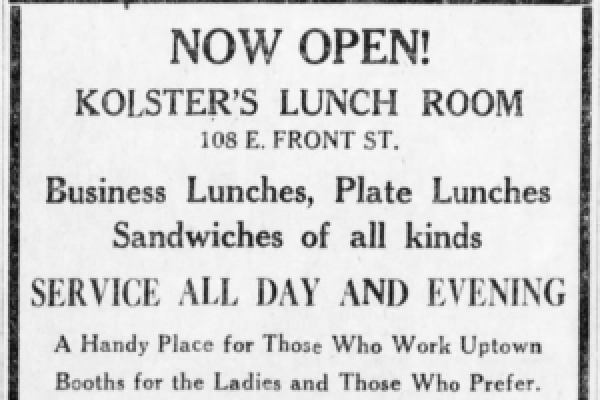
The site saw many additional transformations during this time including becoming the “Fern Fruit Store and Lunch Room” under proprietor W.H. Kolster. Unfortunately, this venture was short-lived, going bankrupt after only a brief period of operation.
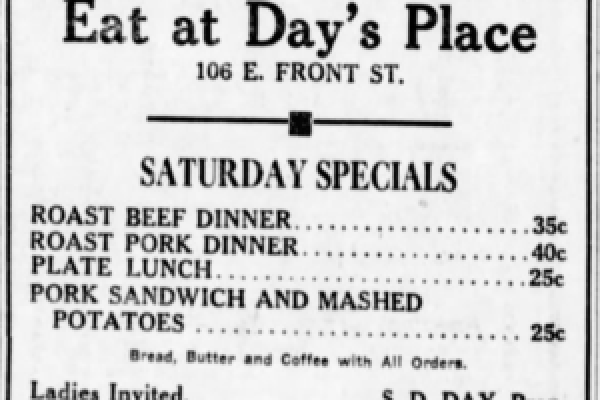
The 1920s brought a series of changes to 106 E. Front St. In the mid-1920s, it operated as a restaurant known as Day’s Place, owned by S.D. Day. This was followed by Brown Fruit Co. The late 1920s to early 1930s saw the space occupied by The Morgan Company, a store that sold a variety of items including clothing and paint.
In the early 1920s, it changed hands again, this time to John Feicht and Oscar Dukes. They transformed the former saloon into a soft drink establishment, operating under the name “Feicht & Dukes.”
With the end of Prohibition, September 1933 marked the return of bar/restaurants to the space with the formal opening of “The Hacienda.” This establishment advertised itself as “A Delightful Place to Eat” offering “The Best of Foods” and “Beer Served Clear and Cold at All Times.” They even offered “Favors for the Ladies,” indicating a focus on creating a welcoming atmosphere for all patrons. However, The Hacienda’s run was brief, closing by early 1934.
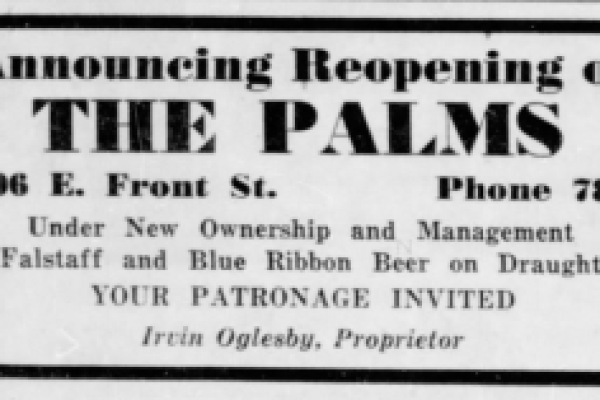
August 1934 saw the grand opening of The Palms under proprietor M.M. Payne. The Palms served popular brews of the time, including Schlitz and Blue Ribbon Beer on tap. In 1937, The Palms reopened under new management, with Irvin Oglesby taking the reins as proprietor.
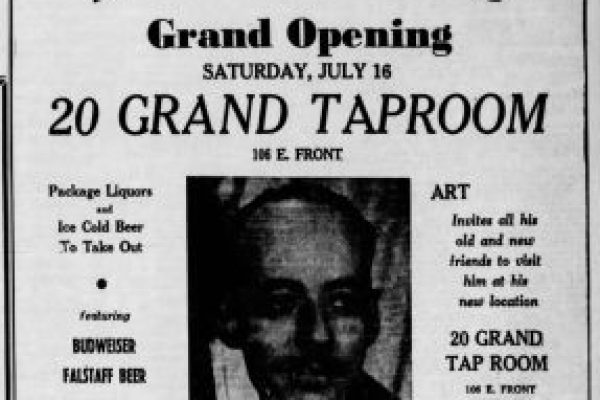
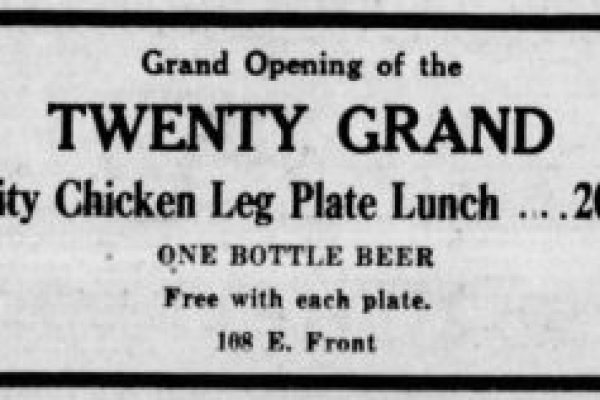
Following The Palms, the next significant chapter in the building’s history began in 1934 with the opening of Twenty Grand at 108 E. Front St. Although initially listed as 108 E. Front St., Twenty Grand would eventually use the address 106 E. Front St.
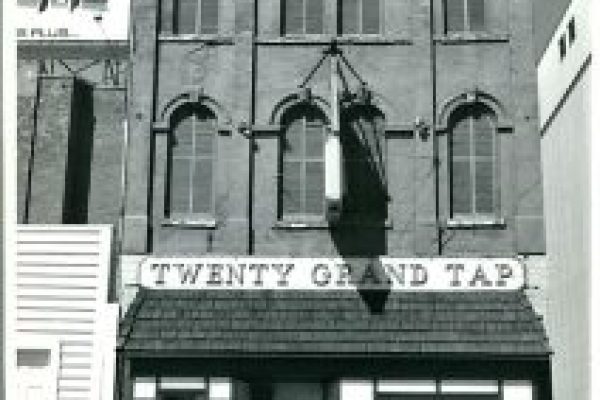
Twenty Grand operated successfully for many years, From 1948 to 1967, the establishment was owned and operated by Lillian Sneyd and her husband, Leo, cementing its place as a local fixture. In the late 1940s it became known as “Twenty Grand Tap Room.”
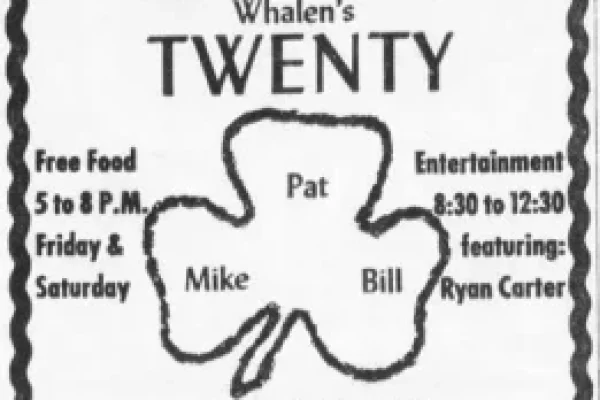
In the late 1960s, after the Sneyds retired, the Whalen brothers – Bill, Mike, and Pat – purchased the business, changing the name once again to “Whalen’s Twenty Grand Tap”. Bill and his wife, Colleen, ran the bar and in 1988 they purchased the building itself from Arline Keefe, taking full control of both the business and property. (It should be noted that in 1980 the neighboring buildings at 108-110 E. Front St. were demolished as part of an expansion project for Bloomington Federal Savings and Loan Association – what is today the Government Center complex.)
Bill and Colleen Whalen continued to run the bar until tragedy struck in April 1991 when Bill was murdered at the establishment. This shocking event marked the end of an era for Twenty Grand Tap.
In 1991, Bob and Cindy Anet, owners of the nearby Central Station Restaurant (now, Epiphany Farms) purchased the building and opened Rosie’s Pub, a “turn of the century tavern” on April 15, 1992.
In 2004, Molly Bradle became the managing partner of Rosie’s, eventually purchasing the business from the Anets. As noted, Bradle stepped away from the business in late June 2024. According to a recent Pantagraph article, Cindy Anet remained as Bradle’s business partner and will be in charge as Bradle moves on to her next chapter.
It’s remarkable to consider the building’s journey through time. From its origins as a bar in 1870, through its various incarnations as restaurants, fruit stores, and taverns, 106 E. Front St. has continuously adapted to the changing times and needs of the Bloomington community.
The building has weathered prohibition, survived unfortunate incidents, and seen countless patrons pass through its doors. It has been a witness to Bloomington’s growth and changes, standing strong even as neighboring buildings were demolished. Each business that occupied this space, from Charles Edelmann’s first-class restaurant to the long-standing Twenty Grand Tap, and now Rosie’s Pub, has contributed to the Bloomington’s rich social and culinary history.
As Rosie’s enters its next chapter , it carries forward a legacy that spans over a century and a half. The story of 106 E. Front St. is more than just a history of businesses; it’s a reflection of the enduring spirit of Bloomington itself, adapting and thriving through changing times while remaining a beloved gathering place for the community.